

Q3 2026 Commercial Mortgage Market Update

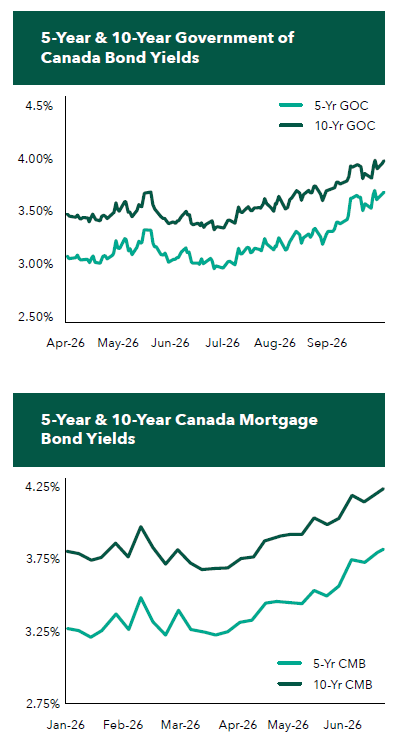
The Federal Reserve and new chairman Warsh voted unanimously for a 25bps rate hike in September. The Iran conflict had kept oil and gasoline prices elevated, adding a new inflation risk at a time when the U.S. economy, household spending, business investment and labour market were still holding up better than expected. The Fed’s concern was not simply the first move in energy prices. It was the possibility that a temporary supply shock could work its way into broader prices, wage demands and inflation expectations before inflation had returned to target. With demand still resilient, the Committee opted for a further 25 basis point increase rather than waiting for the effects to become more entrenched. Since then, a poor showing at the bond auctions left the market stunned, and yields soaring higher with the 20- and 30-year bonds reaching 20-year highs.
The Bank of Canada has held at 2.25%, and Governor Macklem laughably stated that they will make their own decisions independent of what is happening with the Federal Reserve. While an obviously true comment, the policy rates of the two institutions have shown an approximately 0.93 correlation over the past 20 years. Canada does not need to copy the Federal Reserve meeting by meeting, but a sustained U.S. tightening cycle would eventually show up here through the dollar, inflation expectations and Canadian bond yields and the market has correspondingly priced in around a 50bps increase for the end of this year.
Population Growth Was Slower, Not Negative
Statistics Canada revised its population estimates this quarter and, in the process, removed the population decline reported for the prior quarter. The revised data still points to a meaningful slowdown in growth, but it does not support the earlier conclusion that Canada had begun contracting. Much of the revision came from a more complete count of nonpermanent residents. For real estate, the distinction is material. Slower population growth means rental and housing demand should be underwritten more carefully than it was during the surge. A population decline would have been a very different demand signal. The near-term leasing environment remains challenging where large amounts of new product are delivering, especially Toronto and Vancouver, but the long-term housing-demand case is not disappearing.
Lender Competition Is Back, Selectively
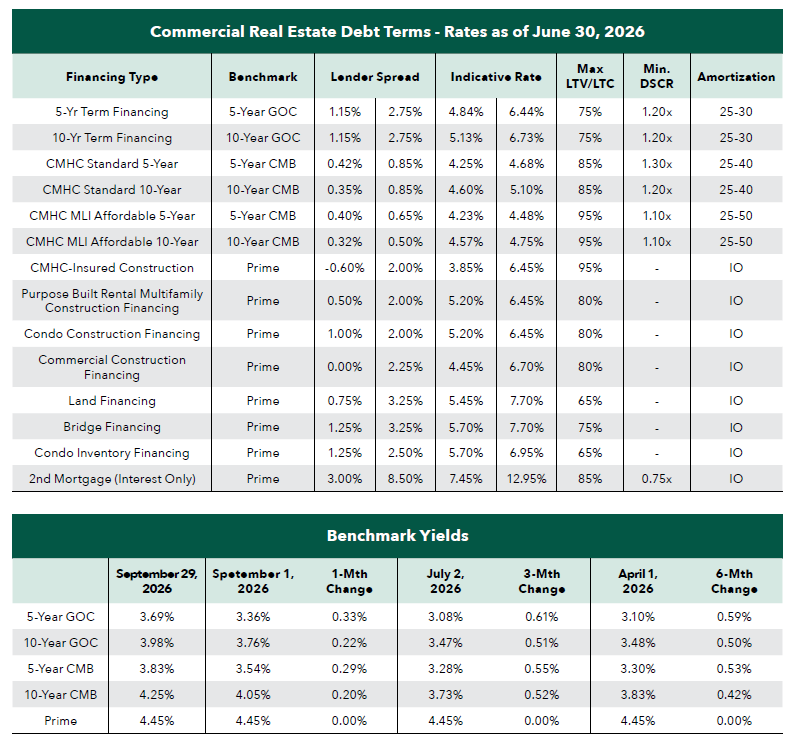
The best term financing deals are now pricing through levels we would not have expected a year ago. For low-leverage, institutional-quality properties, spreads approaching the 110’s are possible, especially for trophy assets with credit tenants.
We would not call this combination unprecedented, but it is certainly not the usual borrower experience. Higher Government of Canada yields normally come with a wider lender margin as risk appetite softens. This quarter, competition and lending deployment have compressed the margin instead. Borrowers should take advantage where they can, while remembering that the all-in rate, not the spread in isolation, remains the relevant number.
Commercial construction financing is also seeing the continued uptick that we noted in Q2, with lenders aggressively bidding to win deals, especially with significant pre-leasing for quality sponsorship. There are deals being accomplished in the market at no spread over the prime rate, with exceptional deals awarded rates below prime in instances where Borrowers opt for CORRA based pricing.
CMHC: The Deadline Passed, the Underwriting Did Not Get Easier
The rush ahead of the September 30 energy-efficiency transition played out as expected. Oakbank processed more than $400 million of CMHC applications in September alone as sponsors moved to submit files before the deadline. That volume will likely be felt in processing times through the fourth quarter, with reports from CMHC underwriters that there are now over 1,200 applications in the queue.
The more important story is that CMHC math has become less forgiving. Test rates are moving up with bond yields, rental underwriting has moved down in a number of markets and operating costs are receiving more scrutiny. Those changes work against each other: less recognized revenue, more conservative debt service and less room to solve a shortfall with leverage. Some markets in the country, especially in certain nodes in Alberta are seeing a dramatic uptick in supply and correspondingly, vacancy.
The CMHC insured route remains the best capital available for qualifying rental projects. It just requires a better file than it did before. Sponsors should be testing rents, expenses and interest rates with enough downside protection to survive a longer approval process and a more cautious final review.
Presale Condo Market: More Government Intervention in the News
As reported last quarter, multiple levels of government are creating avenues for condo inventory to finally start moving. Provincially backed High Art Capital’s reported $22.3 million purchase of 43 unsold units at Line 5 near Yonge and Eglinton in Toronto is one example, reportedly at a sale price just below $800 psf, a steep discount from where the asking prices were at pre-sale. High Art plans to operate them as long-term rentals before eventually selling the units to investors. Bulk sales will not suit every project, but where pricing and rental economics work, they can offer developers and lenders another exit.
In an astounding flip-flop, as part of his (wildly unpopular) snap election campaign, Premier David Eby proposed an unsold condo tax on newly completed units left empty and unsold for more than a year. It would begin at 2% of a qualifying unit’s value in year two and rise thereafter. Although the objective is understandable, though misguided, developers already pay to carry unsold units, and remaining construction debt inventory loans can limit their ability to cut prices. Another holding cost might accelerate some sales; workable pricing, lender flexibility and rental buyers almost certainly matter more. High Art’s Ontario purchase illustrates an alternative exit, not the likely effect of a B.C. tax. For new condo financing, credible presales, sponsor equity, purchaser closings and a plan for remaining units still come first.
Conclusion
With bond yields elevated and the market betting on future increases, waiting and hoping for lower rates carries a risk of its own and is not a viable business strategy. Higher rates are likely to remain part of the market for the foreseeable future, and transactions should be evaluated against the terms available today rather than a hoped-for decline. The experience of 2008 is a reminder that lender liquidity and credit availability can contract quickly when economic conditions deteriorate. A lower bond yield offers little advantage if financing is no longer available on workable terms. Where a transaction is sound and lender interest is in hand, securing that capital and moving to execution will almost always be the stronger decision.
Selected Commercial Debt Terms and Benchmark Yields
Sign up for our newsletter
.svg)
.svg)
.svg)